
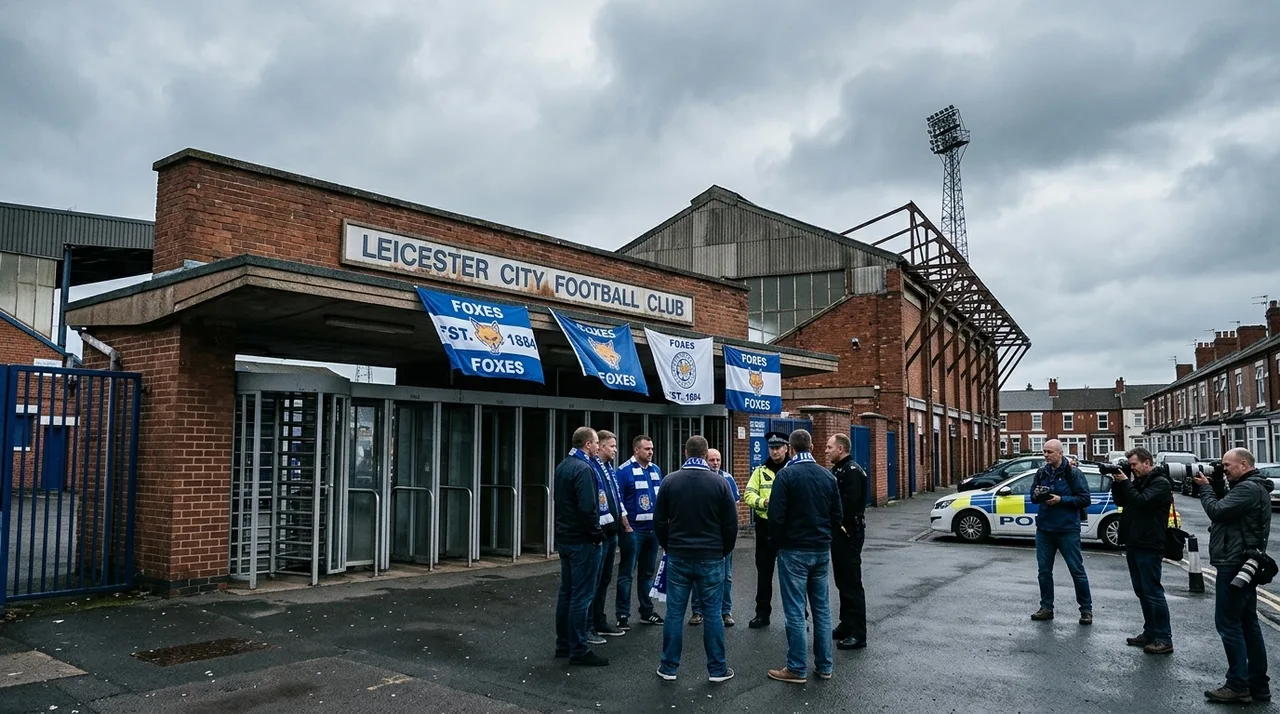
Leicester City, currently competing in League One, are reported to be up for sale, with fresh uncertainty over the club's ownership hanging over what is already a turbulent period in their history.
The news broke via a BBC Radio Leicester discussion on 13 August 2026, in which presenter Owynn and former Leicester striker Matty Fryatt discussed the latest developments surrounding the club's ownership situation. The podcast, titled "Leicester City For Sale", suggests the matter is now firmly in the public domain rather than confined to the rumour mill.
Ownership uncertainty at the worst possible time
For a club of Leicester's size and recent history, the timing could hardly be more unsettling. The Foxes are barely into their League One campaign, and supporters are already absorbing the reality of third-tier football. Adding a for-sale sign above the boardroom to that mix is, to put it plainly, not ideal.
Instability in the ownership of a football club almost always filters down to the pitch. Transfer activity stalls, managerial decisions get second-guessed, and players with options elsewhere start weighing them up. None of that is conducive to mounting the kind of sustained, well-organised promotion push that League One demands.
The source material does not confirm a buyer, a valuation, or a formal process being underway. It is worth being clear about that. What it does confirm is that the ownership situation is sufficiently newsworthy for BBC Radio Leicester to devote a half-hour discussion to it at the start of a new season. That in itself tells you something.
What supporters will want to know
The questions any Leicester supporter will reasonably be asking right now are straightforward: who currently controls the club, who might buy it, and what does either scenario mean for the playing budget?
None of those questions have public answers yet, beyond what Owynn and Fryatt discussed on air. The BBC is not responsible for the content of external sites and the podcast episode itself is the primary source here, so assertions beyond its scope would be speculation dressed up as reporting.
What can be said with confidence is that Leicester began the League One season without a victory, drawing their opening fixture against Notts County. On-pitch momentum, then, is also in short supply. A protracted ownership saga running alongside a difficult start to the campaign is a combination that tests even the most patient fanbase.
The bigger picture for the third tier
Leicester's presence in League One has already reshaped the division in terms of attendances, media attention, and transfer market dynamics. A club under genuine ownership uncertainty represents a different kind of disruption: one that benefits rival clubs if it drags on.
Every week without clarity is a week in which planning is harder, squad depth is harder to address, and the kind of coherent football identity that wins leagues becomes harder to build. Promotion from this division is far from automatic for any club, regardless of their historical standing.
The coming weeks should clarify whether this is a story about an orderly ownership transition or something considerably messier. Either way, the supporters following Leicester through League One deserve honest answers rather than press-release reassurances, and sooner rather than later.
Frequently asked
- Are Leicester City for sale?
- According to a BBC Radio Leicester podcast broadcast on 13 August 2026, Leicester City's ownership is under discussion and the club is reported to be up for sale. No buyer or formal sale price has been publicly confirmed.
- Who owns Leicester City in League One?
- Leicester City's ownership situation is currently unclear and is the subject of reported discussions. BBC Radio Leicester covered the topic in a dedicated podcast episode in August 2026, but no definitive ownership details have been publicly announced.
- How has ownership uncertainty affected Leicester City's League One season?
- Leicester began their League One campaign without a win, drawing their opening fixture. An unresolved ownership situation adds to the uncertainty around the club's planning and transfer activity at a critical point in the season.